Overview
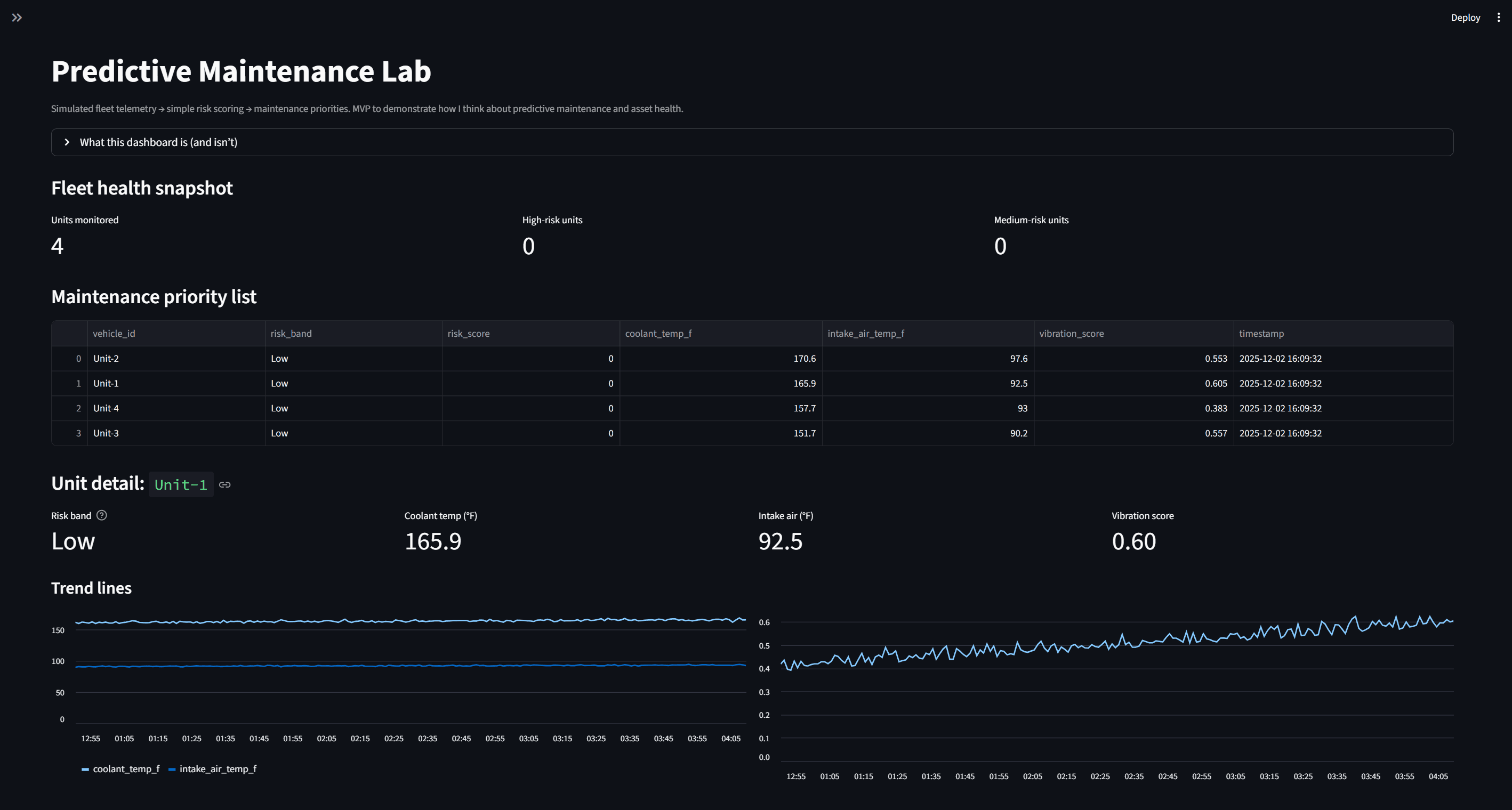
This dashboard consumes simulated fleet telemetry, applies simple maintenance-risk scoring logic, and visualizes the output in a customer-ready interface. Instead of chasing complexity or ML hype, the focus is on clarity: showing the path from signal → risk → action the way a Sales Engineer would explain it in discovery, demos, or value conversations.
The pattern mirrors workflows used across fleet tech, equipment monitoring, manufacturing, and industrial IoT:
ingest time-series data
surface anomalies and emerging risks
prioritize assets that require attention
present information in a way that makes decisions obvious
How It Works
Data Simulation (Python)
Generates multi-vehicle telemetry streams containing metrics such as:
coolant temperature
intake air temperature
engine RPM
vibration score
derived maintenance-risk indicators
Simulates realistic variation across assets to model the noise SEs deal with in real operational data.
Scoring Logic
Applies simple, explainable rules to categorize maintenance risk:
thresholds for normal vs concerning values
per-asset scores rolled into Low / Medium / High buckets
contribution breakdown by signal
This keeps the workflow transparent and easy to walk through with non-technical stakeholders.
Dashboard (Streamlit)
Displays:
top-risk assets
trendlines and outlier spikes
driven-reasoning (“which signals contributed most to the score”)
drill-down into individual assets
The UI completes the workflow by making the technical story frictionless to follow.
Tech Stack & Business Value
Tech:
Python, Streamlit, Pandas, Matplotlib
Why This Matters in a Sales Engineering Context:
This module demonstrates the exact type of narrative SEs deliver around connected systems: how scattered sensor values become structured insights, and how insights become decisions. It’s not just a dashboard; it’s a miniature version of what IoT, fleet, and industrial SaaS platforms do under the hood.
For hiring teams, it showcases:
Ability to simplify and explain data-flow logic
Comfort with time-series patterns and operational signals
Skill in turning raw data into a coherent business story
Familiarity with failure points (noise, spikes, drift, bad data)
Proof you can walk a customer through “here’s the signal → here’s the risk → here’s the next step”